
What’s your move? The ecological influence of personality-dependent space-use patterns in animals
In ecology we often try to answer questions about the processes that determine population dynamics, and interactions between individuals within or between species (e.g., competition for resources and predator – prey dynamics, respectively). The way animals move and use their surrounding is fundamental to many of these processes, with movements scaling up from local searches within a foraging bout, through the home ranges they maintain, to their lifetime tracks.
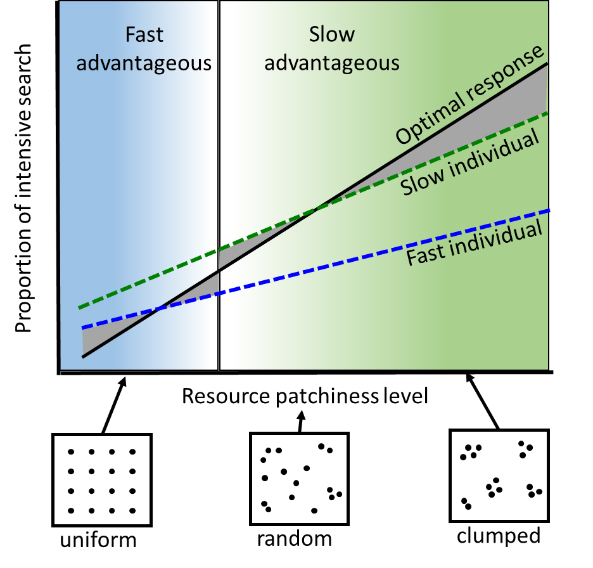
Fig. 1. Search strategy in response to resource aggregation intensities. Lines are the optimal search response (solid) and the individual response by two personalities (dashed). Each personality is advantageous (closest to the optimal) at different aggregation intensities.
Individuals may differ in their behaviors, and show consistently different responses in various contexts. These differences (e.g. in boldness in a risky habitat or in aggressiveness to conspecifics) are often termed ‘behavioral types’ or ‘animal personalities’. It is well known that animals of different personalities may also differ in their tendency to disperse from their natal area. Yet, although for many species dispersal is the longest movement they will do, it is typically also very short with respect to the animal’s life. We know less about how individuals with different personalities differ in other movements, or how such differences affect ecological processes. For instance, understanding these topics better can provide insights into disease spread (e.g., who are the superspreaders? Do they move differently?).
In this study we propose a conceptual framework to address these broader questions, and develop a set of simulation models to demonstrate the carry over effect of individual variation in space-use. We argue that individuals with different personalities also differ consistently in other aspects of their movement (e.g., in foraging) due to various reasons such as the effect of their hormones and genes on their movement, or simply from the way we define personality. These differences, in turn, can affect an individual’s habitat preference (e.g., a particular search-strategy may be more suitable for certain habitat types; Fig. 1); how they use their home-range; how they interact with members of their social network (e.g., mobile individuals may encounter others more frequently); and eventually the spatial assortment of their population (are neighbors likely to be of the same personality or just a random assortment?).

Fig. 2. A sleepy lizard (Tiliqua rugosa) carrying a GPS transmitter. Behavioral assays show that lizards differ in their aggressiveness. Tracking lizards in situ demonstrates that this difference predicts their space use patterns and social network positions, affecting paring behavior and presumably also parasite transmission rates within the population.
Jointly considering consistent individual variation in behavior and movement can explain the remarkable differences we see between individual trajectories. Behavioral ecologists will benefit from linking the measured variation in personality (often measured in the lab) with its ramification in the field. Our framework may also provide a parsimonious explanation for different patterns like personality-dependent social network position, or individual specialization in diet.
Orr Spiegel
Department of Environmental Science and Policy, University of California, Davis, CA, USA
Publication
What’s your move? Movement as a link between personality and spatial dynamics in animal populations.
Spiegel O, Leu ST, Bull CM, Sih A
Ecol Lett. 2017 Jan

Related Articles:
 | Social rank recognition is altered in autism… Humans and many other animals spend their lives in social groups, along with constructing social hierarchy within the groups. Since social hierarchy is a principal determinant for allocation of limited… |
 | Microbial community assembly and the microbiome revolution Microbial communities (i.e. groups of potentially interacting microbial populations that co-exist in space and time) most commonly represent complex and highly diverse assortments of microbial populations, each possessing different genomic… |
 | Layer-dependent fast electron transfer at the… The photo-induced effective interfacial charge separation in Zn phthalocyanine/few-layer graphene heterojunctions has been a promising observation for fabrication of efficient energy-conversion devices. Few-layer graphene are two-dimensional (2D) systems composed of… |
 | Your pharmacist will see you now! Public perception of pharmacists might be limited to dispensing medications. However, pharmacists are trained to deliver patient care to help patients improve their health-related outcomes and achieve their goals. Recognizing… |
 | Waking a sleeping giant: How increasing Africa's… Africa is home to 1.4 billion people, of whom 55 million suffer from cardiovascular disease (CVD). Despite this, Africa contributes to only 1.7% of the world’s cardiovascular science. We studied… |
 | Sleep abnormalities in different clinical stages of… Sleep abnormalities are commonly observed in individuals with schizophrenia and related psychotic disorders. Research shows that over half of people with these conditions have trouble sleeping. Poor sleep also often… |



Leave a Reply
You must be logged in to post a comment.