Tag: viability

  • kINPen09 plasma treatment leads to antimicrobial effects against Candida albicans biofilms

    kINPen09 plasma treatment leads to antimicrobial effects against Candida albicans biofilms

    Microbial communities are an increasing problem in medicine but also in industry. Thus, an efficient and rapid removal of biofilms from surfaces is becoming increasingly important. With the aid of the kINPen09, a radiofrequency plasma jet (RFPJ) instrument, decisive new findings on the effects of plasma on Candida albicans (strain SC5314) biofilms could be obtained. This work showed that the inactivation of biofilms takes place mainly on the bottom, which in turn offers new possibilities for the removal of biofilms by other strategies, e.g., mechanical treatment. This result demonstrated that non-thermal atmospheric pressure plasma is well suited for biofilm decontamination.

    Fluorescence microscopy of plasma-treated biofilms. Atlas of Science
    Fig. 1. Fluorescence microscopy of plasma-treated biofilms.
    (A) Control; (B to F) plasma treatment for 30 s (B), 60 s (C), 120 s (D), 180 s (E), and 300 s (F). The biofilms were stained with SYTO9, showing green fluorescence (living cells), and propidium iodide, showing red fluorescence (dead cells).

    In order to avoid external stresses, microorganisms are predominantly organized in biofilms.  These biofilms have much higher resistance to external stresses like antibiotics or disinfections compared to their planktonic counterparts. This work showed that the non-thermal atmospheric pressure plasma treatment of C. albicans biofilms with the kINPen09 leads to a susceptibility in terms of growth, survival and cell viability. Morphological analysis of plasma-treated biofilms using atomic force microscopy supported the indications for lethal plasma effects concomitant with membrane disruptions and the loss of intracellular fluid. Fluorescence microscopy and confocal laser-scanning microscopy (CLSM) also provided the meaningful evidence that the biofilms were killed by the treatment predominantly on the bottom, where they adhere to the overgrown surface.

    Atomic-force microscopy images of the plasma-treated biofilms. Atlas of Science
    Fig. 2. Atomic-force microscopy images of the plasma-treated biofilms.
    The left panels show topographical images from the top of the biofilm layer, and the right panels show error signal images of the same section. (A) Control; (B and C) plasma treatment times of 120 s (B) and 300 s (C). The images were taken in contact mode with a cantilever spring constant (k) of 0.1 to 0.6 N/m2 and a frequency of 0.4 Hz, the set point at 8 N/m2 , and an area of 20 m2.

    In addition, CFU counts, and fluorescence- and XTT microplate -assays clearly demonstrated a strong negative effect on biofilm cells. These results are particularly significant, as in many industrial processes the decisive factor of decontamination is the biofilm detachment from the overgrown surface. In the course of the flushing processes, the detached biofilm mass is then removed from the facilities, whereby it is not relevant for the process whether the detached biofilm mass is completely dead.

    O. Handorf, T. Weihe, S. Bekeschus, A. C. Graf, U. Schnabel, K. Riedel, J. Ehlbeck
    Leibniz Institute for Plasma Science and Technology (INP), Felix-Hausdorff-Str. 2, 17489 Greifswald, Germany
    Ernst-Moritz-Arndt University, Microbial Physiology and Molecular Biology, Felix-Hausdorff-Str. 8, 17489 Greifswald, Germany

    Publication

    Nonthermal Plasma Jet Treatment Negatively Affects the Viability and Structure of Candida albicans SC5314 Biofilms.
    Handorf O, Weihe T, Bekeschus S, Graf AC, Schnabel U, Riedel K, Ehlbeck J
    Appl Environ Microbiol. 2018 Oct 17

  • Climate change may add significantly to the impacts of pollution and habitat loss on fish populations

    Climate change may add significantly to the impacts of pollution and habitat loss on fish populations

    Climate change is seen globally as a major environmental risk, along with pollution and the loss of natural habitats. Many regions of the world are predicted to experience increasing climatic fluctuations and extremes, including either drought or flooding, but in general most are likely to undergo warming throughout this century. As a consequence species with temperature-dependent sex determination may be especially susceptible to climate change. Warmer temperatures during egg incubation have been shown to induce female-biased populations in many reptiles, including tortoises, turtles and crocodilians. Conversely, in lizards, fish and some amphibians, temperature elevation tends to induce male development, and male-biased sex ratios may be far more problematic for wildlife populations, as the numbers of egg-laying females are reduced. Other environmental stressors predicted to accompany climate change (reduced nutrition, overcrowding, inbreeding and, in aquatic environments, increasing chemical residues, acidification and reduced dissolved oxygen) may also generate male-skewed sex ratios (Fig. 1), and some of these stressors have been shown to have additive effects.

    Fig. 1. Additive effects of environmental stress factors inducing male sex (♂) in fish

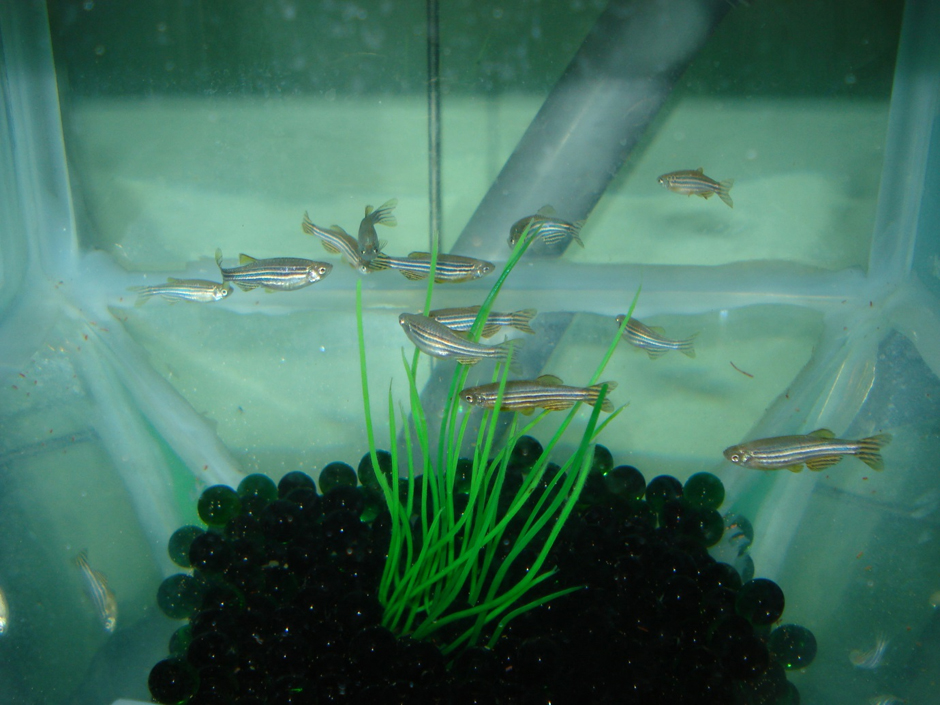
    In order to examine the individual and interactive effects of climate change (warming), habitat loss (causing inbreeding) and pollution (from endocrine disrupting chemicals (EDCs)), collaborating scientists from AstraZeneca, the University of Exeter and Bangladesh Agricultural University conducted a series of laboratory and computer simulations on the zebrafish (Fig. 2). The zebrafish is a widely used model species and was selected for this research because it shows environmental/ temperature-dependent sexual differentiation and rapid maturation, enabling sex to be confirmed in 2 to 3 month old fish. Zebrafish are native to the Indian sub-continent and reproduce and develop during the monsoon season in flooded rice paddy fields, where they may be exposed to various agrochemicals.

    The study chemical clotrimazole is one of many azole fungicides and the selected upper exposure concentration represented total combined azole concentration measured in the field. The laboratory results showed that clotrimazole exposure skewed sex-ratios significantly towards males, and the skew was amplified at warmer water temperatures predicted for the year 2100. Male-skews were also greater in inbred populations (those with reduced genetic variation) compared to outbred (genetically more diverse) populations. The combined effects of all three environmental treatments were shown to be additive, generating almost completely (97%) male populations in inbred zebrafish, maintained at elevated temperature (33°C), together with elevated clotrimazole (8 micrograms per litre) exposure. In contrast, outbred zebrafish maintained at the lower baseline temperature (28°C) with no clotrimazole showed a balanced sex ratio (48% males).

    Fig. 2. Laboratory studies on wild caught zebrafish from Bangladesh

    Laboratory results were then input to a computer-based population viability analysis (PVA) model to simulate the population-level effects of male-skewed sex ratios in zebrafish, and to predict population growth rate and probability of extinction for the various exposure scenarios. After running over 100 exposure scenarios, each one represented by 100 repeat simulations of 100 years of exposure, inbred zebrafish populations exposed to elevated water temperature and clotrimazole were shown to be more likely to decline (56-100% probability) compared with outbred zebrafish populations (0-19% probability). Male-skewed sex ratios of >82% in inbred zebrafish resulted in a three-fold reduction in population growth rate, whereas in outbred fish, larger (>90%) skews were required to induce smaller population declines, amounting to two-fold reductions in population growth rate.

    Overall, the study showed that interactions between elevated temperature and chemicals, which skew sex ratios toward males, can have profound impacts on populations of species with environmental sex determination and/or differentiation. Furthermore, in combination with habitat loss, these impacts are likely to be greater for isolated, inbred and endangered populations.

    Andrew Ross Brown
    Biosciences, College of Life and Environmental Sciences, University of Exeter, UK


    Publication

    Climate change and pollution speed declines in zebrafish populations.
    Brown AR, Owen SF, Peters J, Zhang Y, Soffker M, Paull GC, Hosken DJ, Wahab MA, Tyler CR
    Proc Natl Acad Sci U S A. 2015 Mar 17