Monthly Archives: March 2016
How safe are we handling cytotoxics in academic laboratories in the UK?
Cytotoxics between practice and research Cytotoxics, mainly used in cancer treatment, are defined as agents that are toxic to living cells. Therefore, their handling needs to be carefully monitored in order to protect the user. The latter
Should we use gentamicin cream to prevent exit-site infection in peritoneal dialysis?

Peritoneal Dialysis (PD) is one of the treatment modalities for kidney failure. With PD, the toxins from the blood are removed through the abdominal membrane (peritoneum) into the fluid, which is put into the abdomen through a
Three dimensional quality assurance protocol for thoracic and genitourinary radiation therapy
After cancer diagnosis one treatment option is the use of external radiation. As the radiation traverses the patient it deposits most of its energy in the tumor, which causes irreparable damage to the cancer cells. One type
How can dentist make your teeth shiny?

Because of esthetic demand, light cured dental composites are getting popular in dental practice. The cost of dental composite resin is cheaper than all-ceramic material and is able to fill the tooth cavity immediately and maintain minimally
Melatonin reduces blood pressure and tunes up disrupted circadian rhythms in the seniors

The older we get the more likely our circadian rhythms are disrupted. For example, blood pressure not only tends to increase but as well become more irregular. Luckily, as we show here, melatonin helps to ameliorate both
Stressful childhoods lead to shorter adult height, but via different pathways for boys and girls

As children grow into adults, they face compromises between prolonging growth, and reaching milestones such as puberty and the start of reproduction. They respond to cues in their environment in order to choose the best compromise. In
Silencing a microRNA may keep the doctor away for diabetic wounds

Patients with diabetes are frequently afflicted with impaired wound healing that may progress into chronic, diabetic ulcers, often leading to complications including limb amputation with increased risk of morbidity and mortality. These ulcers occur not only in
The memories of individual ants can make the whole colony less flexible

Social insect colonies are famous for swarm intelligence and collective decision making – being able to come to a unified decision in groups of thousands. An ant colony, for example, can decide which of several food sources
Treatment holidays for patients with metastatic kidney cancer

Targeted therapy is the standard treatment of patients with metastatic cancer of the kidney. The best current therapies target the tumour vasculature thereby blocking the access of the tumour to nutrients and limiting possibility of spreading to
Alternative splicing: the new frontier in diabetes research

The human genome is predicted to contain 22.000 coding genes, but more than 200.000 proteins are expressed in human cells. This discrepancy is explained at least in part by the presence of alternative splicing (AS), a key
HOX genes: The Rosetta Stone of the human cells biology
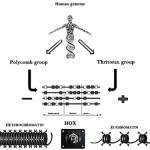
The cell memory program is a biological process that oversees several aspects of the cell life: i) where the new generated cell will be located ii) the fate of a new cell and the cell phenotype; iii)
Infrared does more good than bad for the skin: how can we learn from the sun

In the last decade, it has been proposed that the sun’s Infrared (IR) wavelengths might be damaging human skin and that sunscreens, in addition to their desired effect to protect against Ultraviolet (UV), should also protect against
Closantel return

Fasciolosis is a zoonotic parasitic disease of intrahepatic location caused by the liver fluke Fasciola hepatica. This trematode affects both animals and humans. It is important because the economic losses are generating billions of dollars annually. The
Impacts of life at 2300 m

Populations all over the world live high up in the mountains. The main mountain ranges with long term settlements include the Himalayas in Asia, the Andes in South America and the Ethiopian highlands in Africa. Researchers could
Prior surgical abortion as independent risk factor for preterm birth
Preterm birth is the number one cause of perinatal mortality in many countries, including the US. Defining risk factors for prediction of preterm birth is an important goal for several reasons. First, identifying women at risk allows
Single nucleotide polymorphisms as genomic markers for high-throughput pharmacogenomic studies

DNA is a double strand molecule composed of nucleotide subunits, consisting of three components: a sugar, a phosphate group and one of four nitrogen-containing base, (Adenine, Cytosine, Guanine or Thymine). Among humans, DNA molecules are 99.9% identical.
Energy intensive hub regions of the brain

In this work, we analyzed a massive database of brain connectivity data from the Allen Mouse Brain Connectivity Atlas, which contains data from experiments where researchers inject viral tracers into different regions of the mouse brain. The
Lowering the burden of liver disease in the UK: a blueprint for change

Liver disease is the third biggest cause of premature death in the UK and the number of deaths from liver disease is on the rise (Fig. 1). People can develop liver disease for a number of reasons
A home-based portable instrument to monitor wellness and disease

In the past decade, a number of methods have been made available for health-conscious people designed with the purpose of monitoring wellness and disease information that may be obtained without visiting a conventional and centralized clinical laboratory.
Neurophysiological biomarkers as a method to evaluate effects of drugs

When it comes to treatment of brain diseases not affecting the motor-system, drug development has proven difficult, because the majority of tests of drug-effects in animal experiments rely on changes in the behavior of the treated subject.