Monthly Archives: March 2016
Use of a ‘smart’ ankle-foot prosthesis improves walking stability when descending slopes

The majority of lower-limb amputees walk using a passive artificial limb; meaning the limb creates no power to assist walking. Such limbs incorporate a prosthetic foot that is designed to buckle and/or bend when the walker puts
Family and bipolar disorder: where are we now?
Bipolar disorder is a mental illness characterized by severe high (mania or hypomania) and low (depression) moods that alternate with periods of relative stability (euthymia). Although the frequency and severity of the episodes vary from one individual
The environmental toxin BMAA detected in humans – Cause of neurodegenerative diseases?

Alzheimer´s disease, Parkinson´s disease and ALS ( amyotrophic lateral sclerosis ) are the most common neurodegenerative diseases in the world, and cause tremendous human suffering. Only about ten percent of the cases are hereditary, while the rest
Vitamin D may contribute to development of asthma

Asthma is a chronic inflammatory airway disease, which development mechanism has not been fully investigated yet. Despite the progress of medical science in asthma field, morbidity of this disease remains high worldwide. Scientists raise hypothesis that vitamin
Optically transparent shape memory polyimide- a candidate for flexible optoelectronics

Optically transparent polyimides (PI) have attracted more and more attentions due to their extensive applications in flexible optoelectronics, e. g. plastic substrate of image displays, flexible printing circuit board, optical waveguides of communication interconnects, and liquid crystal
Comparison of the effect of exercise on late-phase LTP of the dentate gyrus and CA1 of Alzheimer’s disease model

There has been a recent upsurge of scientific reports about the benefits of regular physical exercise for general health and particularly for mental health. Healthy diet and physical activity have emerged as promising low-cost measures for protection
Can women themselves assess the outcome of their abortion after an early medical abortion?

In many countries where abortion is legal, women face many barriers from seeking safe and legal abortion services. Most importantly, there is a shortage of abortion facilities and providers in rural areas. In the last few decades,
Medicines – allergic reactions to antiepileptic drugs
Around 1% of the global human population – ca. 65 million – suffer from epilepsy – a chronic neurological disease with one of the most prominent symptoms being so called epileptic seizures. With a range of antiepileptic
Gliomas and the microenvironment

Recently, the term “microenvironment” has been introduced to indicate all the cell types and molecular signaling that in tumors regulates transformation, growth, invasion, therapeutic resistance and defense from host immunity. In malignant gliomas, i.e., glioblastoma, the most
Massive septic pelvic osteolysis following revision total hip arthroplasty in a patient with sickle cell anemia

Sickle cell anemia (SCA) is a hematologic disorder characterized by production of abnormal hemoglobin and often (50%) complicated with bone infraction, hip osteonecrosis etc. Surgical treatment of these complications is often postponed because of a variety of
Enhanced lifestyle satisfaction in severely dependent smokers after quitting

Many smokers are dissatisfied with their tobacco consumption. Smokers often fear significant disadvantages such as intolerable craving, irritability and increased anxiety. This kind of misgiving is especially pronounced among heavy dependent smokers. This study aims to answer
A transcriptomic approach for cardiac (heart) safety assessment
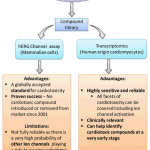
New drug discovery relies on several phases of safety assessment. One such prominent in vitro safety assessment assay is the “hERG potassium channel assay” for cardiac safety. If a compound blocks the hERG potassium channel in a
Cushing’s Disease – why is the diagnosis so difficult?

Cushing’s disease, named after the neurosurgeon Harvey Cushing, and caused by an adrenocorticotroph hormone (ACTH)-secreting benign tumor of the pituitary, is a rare illness. The pituitary is a gland at the base of the brain that secretes
Tuberculosis in ancient bones can also be identified by a protein of the pathogen

As we all know, DNA is the matrix for the proteins and the proteins are the molecules which are involved in every step of the metabolism of all living organisms inside and outside of cells. Without proteins
From Biomass to Medicines: a cellulose derived product as building block in the synthesis of bioactive compounds

The bio-refinery concept is based on replacing fossil fuel with biomass, having the advantage to use renewable natural raw materials. This topic is currently of interest in academic studies, industrial applications and political strategies, both for the
UNC Medical Center reduces time patients wait for their chemotherapy

Lean and Six Sigma principles are used in manufacturing and more recently, healthcare, to eliminate waste, defects, and variability in processes. These philosophies are used to develop solutions to workflow challenges in an effort to improve process
Consuming a probiotic once a day could improve cognitive skills
Probiotics, which are friendly and beneficial bacteria to our bodies, could improve cognitive skills, i.e the ability to learn, memorise, process information or react to events, as demonstrated by researchers at the APC Microbiome Institute, University College
Is there a place for Tooth Mousse in the prevention and treatment of early tooth decay?

Despite significant improvements in oral health over the past forty years, tooth decay remains one of the most common health problems worldwide. The level of tooth decay found in low income and socially-disadvantaged areas remains a public
Light enhances the blood glucose monitoring with naked eye

Enzymes play an important role in the body of a plant or animal. Natural enzymes have been extensively investigated and widely applied in industry because of their excellent properties, including high substrate specificity and catalytic efficiency. However,
Excess mortality associated with second hip fracture

Hip fracture increases death risk. Ten percent of survivors have second hip fracture. It is not known if second hip fracture further increases death risk. Here, we report that second hip fracture increases death risk beyond that