Yearly Archives: 2016
Prior surgical abortion as independent risk factor for preterm birth
Preterm birth is the number one cause of perinatal mortality in many countries, including the US. Defining risk factors for prediction of preterm birth is an important goal for several reasons. First, identifying women at risk allows
Single nucleotide polymorphisms as genomic markers for high-throughput pharmacogenomic studies

DNA is a double strand molecule composed of nucleotide subunits, consisting of three components: a sugar, a phosphate group and one of four nitrogen-containing base, (Adenine, Cytosine, Guanine or Thymine). Among humans, DNA molecules are 99.9% identical.
Energy intensive hub regions of the brain

In this work, we analyzed a massive database of brain connectivity data from the Allen Mouse Brain Connectivity Atlas, which contains data from experiments where researchers inject viral tracers into different regions of the mouse brain. The
Lowering the burden of liver disease in the UK: a blueprint for change

Liver disease is the third biggest cause of premature death in the UK and the number of deaths from liver disease is on the rise (Fig. 1). People can develop liver disease for a number of reasons
A home-based portable instrument to monitor wellness and disease

In the past decade, a number of methods have been made available for health-conscious people designed with the purpose of monitoring wellness and disease information that may be obtained without visiting a conventional and centralized clinical laboratory.
Neurophysiological biomarkers as a method to evaluate effects of drugs

When it comes to treatment of brain diseases not affecting the motor-system, drug development has proven difficult, because the majority of tests of drug-effects in animal experiments rely on changes in the behavior of the treated subject.
Use of a ‘smart’ ankle-foot prosthesis improves walking stability when descending slopes

The majority of lower-limb amputees walk using a passive artificial limb; meaning the limb creates no power to assist walking. Such limbs incorporate a prosthetic foot that is designed to buckle and/or bend when the walker puts
Family and bipolar disorder: where are we now?
Bipolar disorder is a mental illness characterized by severe high (mania or hypomania) and low (depression) moods that alternate with periods of relative stability (euthymia). Although the frequency and severity of the episodes vary from one individual
The environmental toxin BMAA detected in humans – Cause of neurodegenerative diseases?

Alzheimer´s disease, Parkinson´s disease and ALS ( amyotrophic lateral sclerosis ) are the most common neurodegenerative diseases in the world, and cause tremendous human suffering. Only about ten percent of the cases are hereditary, while the rest
Vitamin D may contribute to development of asthma

Asthma is a chronic inflammatory airway disease, which development mechanism has not been fully investigated yet. Despite the progress of medical science in asthma field, morbidity of this disease remains high worldwide. Scientists raise hypothesis that vitamin
Optically transparent shape memory polyimide- a candidate for flexible optoelectronics

Optically transparent polyimides (PI) have attracted more and more attentions due to their extensive applications in flexible optoelectronics, e. g. plastic substrate of image displays, flexible printing circuit board, optical waveguides of communication interconnects, and liquid crystal
Comparison of the effect of exercise on late-phase LTP of the dentate gyrus and CA1 of Alzheimer’s disease model

There has been a recent upsurge of scientific reports about the benefits of regular physical exercise for general health and particularly for mental health. Healthy diet and physical activity have emerged as promising low-cost measures for protection
Can women themselves assess the outcome of their abortion after an early medical abortion?

In many countries where abortion is legal, women face many barriers from seeking safe and legal abortion services. Most importantly, there is a shortage of abortion facilities and providers in rural areas. In the last few decades,
Medicines – allergic reactions to antiepileptic drugs
Around 1% of the global human population – ca. 65 million – suffer from epilepsy – a chronic neurological disease with one of the most prominent symptoms being so called epileptic seizures. With a range of antiepileptic
Gliomas and the microenvironment

Recently, the term “microenvironment” has been introduced to indicate all the cell types and molecular signaling that in tumors regulates transformation, growth, invasion, therapeutic resistance and defense from host immunity. In malignant gliomas, i.e., glioblastoma, the most
Massive septic pelvic osteolysis following revision total hip arthroplasty in a patient with sickle cell anemia

Sickle cell anemia (SCA) is a hematologic disorder characterized by production of abnormal hemoglobin and often (50%) complicated with bone infraction, hip osteonecrosis etc. Surgical treatment of these complications is often postponed because of a variety of
Enhanced lifestyle satisfaction in severely dependent smokers after quitting

Many smokers are dissatisfied with their tobacco consumption. Smokers often fear significant disadvantages such as intolerable craving, irritability and increased anxiety. This kind of misgiving is especially pronounced among heavy dependent smokers. This study aims to answer
A transcriptomic approach for cardiac (heart) safety assessment
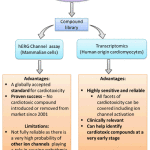
New drug discovery relies on several phases of safety assessment. One such prominent in vitro safety assessment assay is the “hERG potassium channel assay” for cardiac safety. If a compound blocks the hERG potassium channel in a
Cushing’s Disease – why is the diagnosis so difficult?

Cushing’s disease, named after the neurosurgeon Harvey Cushing, and caused by an adrenocorticotroph hormone (ACTH)-secreting benign tumor of the pituitary, is a rare illness. The pituitary is a gland at the base of the brain that secretes
Tuberculosis in ancient bones can also be identified by a protein of the pathogen

As we all know, DNA is the matrix for the proteins and the proteins are the molecules which are involved in every step of the metabolism of all living organisms inside and outside of cells. Without proteins